Thursday, 6 September 2012

Film #48 - Robot and Frank


I don’t know who Susan Sarandon’s agent is these days but, frankly, he or she could do with a raise. For an industry that famously gives short shrift to older actresses this is the second small-scale, solid film I’ve seen her shine in this year (after Jeff, Who Lives At Home which I actually saw at TIFF last year).

Not that Sarandon is the centrepiece of this debut scifi-comedy from director Jake Schreier, she is more the icing on the already very sweet cake.

Robot and Frank is set in the “near” future, where robots have begun to take over many of the menial (and less menial) roles once performed by human. The curmudgeonly Frank (played by the coincidentally named Frank Langella) is making the worst of his retirement and showing alarming signs of developing severe dementia. His frazzled, jaded son Hunter (James Marsden), frustrated with weekly ten hour journeys to ensure Frank stays alive decides to solve the problem by buying Frank a robotic android in the Honda Asimo style whose programming is to prolongate Frank’s independence through diet, exercise and maintaining mental acuity.

You'll be glad to know they still have
trees in the near-future.
An old-school thinker, Frank is far from impressed by Robot (rather distractingly voiced by Peter Sarsgaard) impinging on his scattered lifestyle until he discovers that it would be the perfect accomplice in his old racket of cat burglary. As the object of Frank’s affection Jennifer’s (Susan Sarandon) job comes under fire as hipster yuppy Jake (Jeremy Strong) buys out the library she works and seeks to turn it into a merely-ironic celebration of the printed word, Frank hatches plans for vengeance and incorporates Robot into his schemes. Robot, seeing the dramatic improvement in Frank’s health statistics as he plans his newest burglary, feels programmed to comply. From there an unlikely friendship between the two blooms.

As high-concept as Robot and Frank may sound, what works about it is that it keeps things on a very low-key level. The film is careful to position the plot only a few years in our future (Frank’s adult children are called Hunter and Madison after all) which lets it get away with featuring only mild changes from the present day and keeps the robots peppered through the script at a relatively low-tech level.

If you want me to think he's demented, I'm not sure telling me
he has a crush on Susan Sarandon is the best way to achieve it
Similarly the plot doesn’t have grand ambitions for where it is going with the concepts, holding to more of a character study of Frank himself and his evolving mirror, Robot. Frank isn’t planning to jack a casino, merely enact petty revenges on the people making Jennifer’s life difficult. For a first time feature director to keep his vision so containable is a great idea as it has allowed Schreier to focus much more on key elements rather than getting lost in the effects.

With Langella and Sarandon in the leads, it almost goes without saying that the performances are excellent though the warmth each brings to their role is certainly a delight during the relatively quiet second act. To a lesser degree Marsden and Liv Tyler (as Frank’s daughter Madison) help round out the emotional nuance though Marsden is asked to switch gears a few too many times in the final act to get a good bead on his character. Jeremy Strong is surprisingly effective as the obsequious Jake those his severe rattling in the third act diminishes some of what he’d achieved previously in the film.

Although, Robot and Frank is certainly a solid film with solid writing, you can’t help but feel a little bit frustrated that the script doesn’t nail its colours to the mast in terms of what it is actually about and investigate that idea a bit more fully.

What a hellhole this library is!
The script varies from being an interesting look at the way the rise of technology will challenge and change human interaction with the world around them to the somewhat more generic take on a family’s loss of identity as one of their members succumbs to a degenerative disease. Ultimately it plays it safe on both counts (technology is interesting, Alzheimer’s is sad) and thus fall a bit short in saying anything definitive about either.

For example, Frank’s motivating factor is the threat Jennifer’s job as a librarian comes under when Jake wants to revisualise the concept of a library as a communal space. But Jake’s belief is already clearly in evidence in libraries around the country in the present day, so to present it as something scandalous in the near future is a bit disingenuous. Not that we ever get a clear sense of exactly what Jake actually hopes to achieves, so it all just seems to boil down to ‘books are good, yuppies are dumb’. It’s this sort of thing that makes me worry that Robot and Frank’s relevance won’t last long enough to see the year it purports to be set it.

Which is sad because it is a rather sweet film. It’s got Ana Gasteyer in it and all.

Tuesday, 28 August 2012

Film #47 - ParaNorman


What is there to say about ParaNorman, the new animated kids horror-comedy heavily touting itself as being from the makers of Coraline. Well, firstly that it’s no Coraline, though at least you can see that it’s trying to wear get up from the same costume chest.

Right from the opening moments, it’s clear that ParaNorman doesn’t quite have what it takes. It just doesn’t seem to understand the world at all. The jokes aren’t funny, the drama is overwrought, the characters run into clichés very quickly if they didn’t begin that way. If it weren’t a movie specifically intended for kids, a reviewer could get very frustrated.

All of that said, ParaNorman isn’t exactly bad so much as it isn’t much of anything.

The plot runs thus: Norman Babcock (voiced by the now ubiquitous Kodi Smit-McPhee) is a tween much maligned in in his home town of Blithe Hollow for his ability to speak to the dearly departed. When his uncle (John Goodman, having more fun than anyone else here), who shares his talent, passes away, it is revealed that Norman is the heir to the legacy of annually preventing the awakening of a centuries old witch, whose backstory is also the town’s primary tourist attraction, and a small army of zombie Puritans. Of course, inevitably the witch’s curse is activated and Norman must ally himself with a team of unlikely helpers to force the witch back into her grave before she destroys the entire town.

Yes, the fat nerd has a heart of gold. Try and look surprised.
It sounds like a solid enough plot and with a few elements in play to make it different from every other film with a similar story, it may have worked. Sadly,  the elements of ParaNorman that do stand apart are largely minor and often not targeted at the child audience.

What is perhaps an eyebrow raiser is how cynical the film is for a children’s movie. It is absolutely assumed that people will always act at their worst; the adults are wan, drawn and thwarted and very little hope for anything better break through, even in the denouement.

That’s potentially interesting, given the subtext of the film is about the relationships between bullies and victims, including some fairly cloying but not inaccurate commentary about how those roles can sometimes be reversed.

Also, somewhat surprising is the frank take the film has on child sexuality where Norman’s putative friend Neil (Tucker Albrizzi) is very clearly shown as having an overt sexual interest in adult women and whose older brother  Mitch (Casey Affleck) is openly goggled as a sexual object, including gratuitous underwear and towel-clad sequences.

It's important to teach kids poor body image from an early age.
Presumably the terrible hair is to distract you from his underwear?
Considering Neil’s aerobics models asses and jock brother Mitch’s shirtlessness are both animated, it’s less likely they’ve been thrown in to titillate the young audience so much as that filmmakers Chris Butler and Sam Fell simply assume that these are already quotidian aspects of their lives. I’m not sure I entirely disagree.

It is worth mentioning briefly the visual of the film which is actually fairly impressive as it blends CGI, modelwork and, if I'm not mistaken, even some live shooting. the supernatural touches as the witch's curse really takes over the town are particularly well-flourished and Norman's final confrontation with her is as visually satisfying as the cryptic finale of an anime piece. Presuming you like that stuff.

Indeed, to be fair to ParaNorman, it handles visuals and action sequences fairly well, which is perhaps its real hand-me-down from Coraline, given that the theme and setting didn't gel. The third act, where events go truly paranormal, is certainly the saving grace of the film. There’s just not enough here to recommend this for anything above DVD viewing.

Friday, 24 August 2012

Film #46 - For A Good Time, Call


It would be tempting to give Bridesmaids the credit for a film like For A Good Time, Call but it was apparent from the Q&A after this sneak preview in Toronto last night that the script had been kicking around for a lot longer than that.

Instead it’s probably more a case of Bridesmaids’ success finally proving to the marketing geniuses that there really is an audience out there for films about the sexier, sillier side of the female experience and the barriers that stopped films like FAGTC emerging earlier have finally started to emerge.

Sorry, I have a personal cross to bear with the idea that the marketing department should be the final say in whether a film gets green lit or not.

While we’re on personal disclosure, I was at this screening as the guest of one of the stars/co-writer’s relatives. So, if you think that will bias my opinion, you should probably know that in advance.

Ignore the pink phone and the landline, this film is
actually not set in the 90s. I had thought phone sex itself was
set in the 90s but my lady friends tell me I'm wrong
For A Good Time, Call concerns itself with the affairs of Lauren (Lauren Miller) and Katie (Ari Graynor) who, despite hating each other, are forced to live together as a result of socio-economic circumstances. The initially frigid relationship between the two begins to thaw when the uptight Lauren discovers that the free-wheeling Katie is making bank on the side by working for a phone sex line. Applying her business acumen to the idea, Lauren soon figures out how to set Katie up her own sex line and gets drawn into a world of sexual exploration she had never dreamed of entering.

The hook for the story, and most of the best jokes, revolves around the sex, the perverted things men ask of the women and their reactions to them. But, just like Bridesmaids is not about weddings, the phone sex line is not the real subject of the film.

2012 has been a good year for mainstream films giving greater dimension to traditionally clichéd female relationship with Snow White and the Huntsman tackling female rivalry and Brave handling mother-daughter relationship. For A Good Time Call continues the trend with its treatment of arguably one of the most portrayed and most unexplored questions: what makes women friends?  Focusing on the start of the real relationship between these women makes this less of an indie version of Bridesmaids though and more of a female version of I Love You Man.

Lauren is secretly glad her housemate
has never heard of Cam4
Sadly, For A Good Time Call is far from a definitive voice on the subject. Although the pacing of the relationship of the women is well managed there’s a slight sense that we’re on rails here and their friendship blossoms because it is a story requirement rather than because the writers have anything greater to say about the subject. This is particularly noticeable around the second act turning point where all of the story elements we expect to play out did indeed play out in exactly the sequence we expected.

That again I suspect is less of an issue with the writers themselves than with the notes they’ve received as most of the script is very polished and feels as natural as one of this genre probably can. In a year where mainstream scripts have struggled with pacing and pathos, For A Good Time Call is never boring and its never a mystery as to why you might care about what happens to the two leads.

This is of course helped by the sympathetic performances coming out of Miller and Graynor, particularly in the latter’s case as she balances a tough girl exterior reminiscent of Bette Midler’s CC Bloom with a vulnerability reminiscent of Bette Midler’s CC Bloom. Girl reminded me of CC Bloom is what I’m saying here.

Although the men in the film are, without exception, inconsequential there are a number of amusing cameos from good sports like Seth Rogen, Kevin Smith and Ken Marino as some of the callers in.

It's OK, Jesse, you've set Act 1 in motion, you can leave now.
Justin Long also hangs around as Jesse, the mutual gay friend of both women who engineers their living situation in the first place but doesn’t provide much after setting events in motion. And frankly, for an actor who I seen great stuff from before, he does not acquit himself at all well here. I was wondering if Long had ever even met a gay person in his life until the Q&A afterwards revealed he based his character on the gay director, Jamie Travis. Considering we got to meet Travis in the Q&A itself I would now like to formally protest any plans Long had to play me in the biopic of my life. 

I’m sure he’s hurting.

All in all, For A Good Time Call is very sweet, often quite quite funny and an excellent debut for both Jamie Travis and a director and Lauren Miller/Katie Anne Naylon as writers. It’s not going to set the world on fire by any means but is a thoroughly enjoyable 90 minutes.

Friday, 17 August 2012

Film #45 - Boy


Kiwi director Taika Waititi’s Boy is actually two years old by this point but has only just managed to jump the Pacific for a Toronto-based release and, having been starved of Australian content for most of my time here, I was eager to see what the fuss was all about.

The fuss, of course, referring to the near-universal acclaim showered on Boy in New Zealand following its release and where it still holds the record for the highest grossing New Zealand film of all time (for obvious reasons we’re not counting Lord of The Rings under this category). Even in Australia it was regarded as one of the best films of 2010.

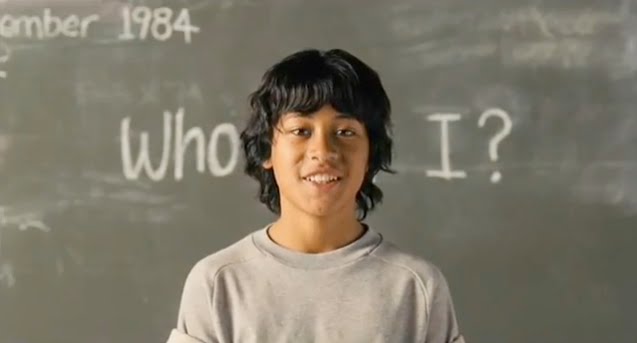
On the surface it may seem a bit out of proportion. Boy, after all, is a fairly standard coming-of-age yarn. The eponymous character, the 11 year old Boy (real name Alamein, and played by James Rolleston) is growing up in 1984’s Waihau Bayon New Zealand’s east coast, as the de facto primary caregiver for a large family of cousins and filling the holes in his life with fantasies about his long-absent father (also Alamein, and played by Waititi himself) and pop-star Michael Jackson. 

Poverty and chronic unemployment abound but through the prism of Boy’s imagination, it’s a fairly idyllic existence. Until the night when Alamein arrives unexpectedly back in Boy’s life and Boy begins a long coming of age where he will be forced to question everything he’s ever believe about his father and the world as he knows it.

You can see the script redrafting process at work
as this question moves out of the centre to make way for
"What kind of man will i be?"
What may make Boy such a cause celebre is just how well the individual  elements of its story are handled. 

The entire film performs a very delicate tightrope act of dramatic irony where the audience understands full well how dire Boy’s situation really is but the main character’s levels of delusion and optimism manages to keep the real world horrors of poverty, drug use, neglect, and violence at arm’s length from a story that is steeped in them.

Boy is a remarkable feat in that it’s a film that doesn’t pull any punches by pulling all of its punches.

Waititi’s previous feature, the “rom-com” Eagle vs Shark, was a master class in sheer awkwardness as the basis for comedy and Waititi builds on the tricks he deployed there to achieve even greater effect in Boy

Whereas EvS laid on stilted dialogue and delusion to make for jokes, the unavoidable humour they create in Boy helps to underline how serious all this stuff really is even as it makes it possible to stomach.

At its heart, Boy is a film about the way people use their delusions to stop themselves confronting their problems – and I suspect we’re specifically looking at male delusion here.

The men of 'Boy' in order of how seriously they
take this game from left to right
Alamein has fantasies of himself as a big time gangster exerting influence over his contemporaries even though he refuses to work to achieve any of his goals. 

Boy will not look past his image of a perfect father figure to see that his abusive pa has severe feet of clay. 

Even Boy’s six year old brother Rocky wraps himself up in the conviction that he has superpowers as a way of exploring his guilt over the fact their mother died during his birth.

By the film’s climax, all three will have to make a choice about whether to continue deceiving themselves and sabotaging themselves or whether to start living in the grim world the way that it actually is and the nuanced way in which each arrives at that point and what they do once there is captivating.

Seriously, sit through the credits for this sequence.
Matters are helped by the effusive performances of the main three stars which again helps to temper some of the more depressing material with a sense of zest and optimism. 

Boy and his clan may not have a lot of options on the horizon but they’re so likeable as they fail that you can’t help wanting to go along for the ride. 

Waititi, as Alamein, has the hardest job here as his character has such a damaging effect on his sons that it’s near impossible to sympathise with him as her terrorises and disappoints them but Waititi is so adept at playing up just how deeply Alamein doesn’t get it that you can at least understand his devastation at the realisation that his life has been a joke even if you can’t forgive him for it.

But as always seems to be the case with these films, it’s the kids that steal the show. And though James Rolleston’s mixture of bravura and innocence hit the target bang on, it’s Te Aho Aho Eketone-Whitu as Rocky that stayed with me after the show. For a six year old actor, Rocky comes across with more gravitas and understanding than anyone else in the film and figures out what needs to be figured out long before either Boy or Alamein.

There are women in Boy. The fact their stories are not covered
at all is, for once, not an oversight so much as a point
about the inner lives of the central characters
I suspect Boy is at least semi-autobiographical, Waititi is certainly the right age to have been Boy in 1984 and Waititi certainly captures the era in loving detail and with a verisimilitude that had me recalling moments of my own childhood on the other side of the Tasman.

Some slight caveats here. Boy is a slow burner and big on its subtlety so it’s more suited for an arthouse mindset than a cineplex one and North Americans are likely to struggle with the Kiwi accents. 

If you’re willing to adapt though, Boy is a thoroughly enjoyable, scarily accessible window onto a time and culture that feels sufficiently different to be a new experience yet familiar enough to feel like home.


Wednesday, 8 August 2012

Film #44 - The Dark Knight Rises


And so we get to arguably the summer’s biggest flick – the culmination to Christopher Nolan’s sprawling Gotham trilogy, The Dark Knight Rises.

By this stage both Nolan and his trilogy have had so much adulation lapping at their feet that it’s nearly impossible to say anything against The Dark Knight Rises and not come across as being a bit contrary. Yet, for all of Nolan intricate cerebral mechanics and call backs to Batman Begins and the Dark Knight, the lustre seems to be off a bit this time round and TDKR impresses more for its intellectual audacity than any visceral joy.

I know. I’m a hard man to please.

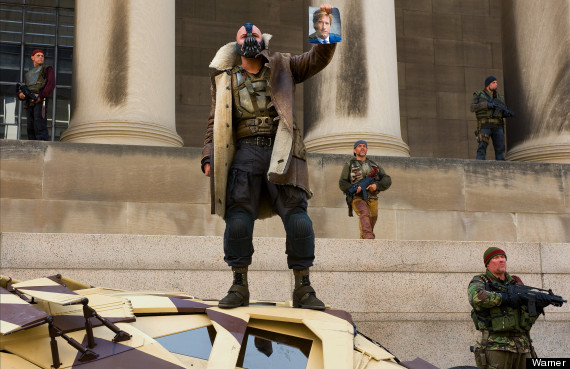
Even Bane is a fanboy
Set eight years after the events of The Dark Knight, Gotham is enjoying a precarious golden age as the city’s devotion to the deceased Harvey Dent has allowed a series of draconian laws to be quietly ushered in, breaking the Mob’s grip on the city. Batman, who took the fall for crimes Dent committed, has vanished and his alter-ego Bruce Wayne has taken on a Howard Hughes-like existence scuttling in the abandoned corridors of Wayne Manor. Gotham’s prosperity hasn’t been universal though and, as the remains of Gotham’s underworld plots to rise again, they make the mistake of hiring criminal mastermind Bane who promptly raises an army from among Gotham’s diaspora and readies them for a war much more wide-reaching than his employers have in mind. As Batman begins to re-emerge from the shadows, Bane sets his sight on breaking the Bat – in every conceivable way.

It sounds like a standalone plot, but one of TDKR’s major strengths is how well the events of the film tie into events that happened elsewhere in the trilogy, including many more references to series-starter Batman Begins that I would have expected.

But even as TDKR impresses with its grandiose vision and complexity of the trilogy as a whole, I’d argue that the potential flaws in Nolan’s vision have never been so obvious either. I say ‘potential’ because whether you regard them as flaws or not really depends on how much you’ve bought into what Nolan has been doing quietly to date but which comes back resoundingly this time around.

It almost goes without saying that Nolan’s Batman trilogy is not really about Batman at all but rather Batman merely serves as a convenient symbol for the city of Gotham itself. In Begins, the city learns to rise above the fear that has held it stagnant for decades; in The Dark Knight, it exhibits a core of goodness and hope that refuses to give in even when it has every reason to. And in TDKR it pays the brutal price for not standing up for the values it once aspired to.

It’s beautiful, laudable stuff. Nolan isn’t really making superhero films here, even as he reinvents superhero films, so much as gripping crime dramas about nations of people. The problem is, for me at least, the closer the Bat moves into symbolism, the sillier the Batman looks in reel life.

Considering how much TDKR caps off the trilogy, it’s a little odd that Nolan essentially rescinds the Batman’s use of fear and secrecy as a crowd control technique here. Batman fights in broad daylight here, one of a throng of people, his fights in the midst of audiences and appears as clearly merely a man in front of groups of citizens even as he tries to inspire with some symbolic pyromania. It may be a metaphor I just don’t get, but I just don’t get it.

I'm only using this photo to prove that Bruce
does put on the suit at some points
And he is undercut in a myriad of ways throughout TDKR. He’s barely onscreen as Bruce Wayne does most of the heavy lifting, everybody in Gotham seems to know his secret identity by now and he’s oddly ineffectual. It doesn’t help that his early set-piece brawl with Bane is portrayed in near-silence, rendering events strangely boring.

It kind of overshadows proceedings. Without anyone to really get behind in the central role, it wasn’t as absorbing an experience as watching The Dark Knight and I often felt more like a wind-up toy compelled to watch until my spring ran down than an active participant in the film’s events.

Ironically, The Dark Knight could probably have gotten away with more of this, given the mesmeric presence of The Joker to spice things up. But Bane is no Joker, with all due respect to Tom Hardy who gives his all. Between the facial expression obscuring mask and the convoluted yet seemingly directionless plot (does he achieve his goals at the midpoint? Is there more to his ambition?), he’s not given enough to be a driving force either.

She might look like a t cat, but thankfully, she doesn't think she is one.
Much more successful and more humane is Anne Hathaway’s turn as the Catwoman, who (much like Michelle Pfeiffer in Batman Returns) add a jolt of pleasure nearly every time she’s onscreen. Selena Kyle’s (she’s never referred to as Catwoman) journey throughout the film is the easiest to understand and engage with and Hathaway treads just the right line between mischievous villainy and conflicted pathos to keep us on board. Yes, Kyle is the stereotypical femme fatale but it’s not the worst cliché to throw at us and Hathaway at least gets into it with gusto.

Wednesday, 25 July 2012

Film #43 - The Amazing Spider-man


Well if you’re going to call your film The Amazing Spider-man, you’re really setting the bar quite high for yourself. Fortunately Amazing Spider-man delivers, at least with regard to its central character.

Yes, it hasn’t been that long since Sam Raimi’s take on the friendly neighbourhood webslinger wrapped up with Spider-man 3. The entire Internet and its dog has already commented on this. But two things are worth thinking about. It’s still a whole decade since the franchise was rebooted (possibly this was timed so Sony could retain the character rights? I’m unclear on that) and a whole five years since we last saw Spidey onscreen (I think the gap between Batman and Robin and Batman Begins was only eight years, and B&R was a much more thorough franchise destroyer than Spider-man 3).

So we’ve got a whole new team on board, including the surprising directorial choice of Marc Webb, who’s probably best known for the making the romcom genre momentarily bearable with 500 Days of Summer who not typically necessarily be anyone’s first choice to direct a superhero film.

And especially not a superhero film that’s so in touch with modern tastes. The Amazing Spider-man wears its debt of gratitude to Christopher Nolan’s Batman trilogy on its sleeve, eschewing the brighter palette of Raimi’s take on the character for a grimmer greyer New York.
Stunts this time round are more acrobatic less web slingy enabling
Webb to shoot some impressive action sequences in tight quarters

It may be the grittiest of the Marvel adaptations of recent years (an interesting choice given that Spider-man’s appeal to younger children). Of course the Spider-man franchise takes place in a separate universe to the Marvels other Avengers-building films (so no Spidey in Avengers 2 L), which may give Webb a bit freer rein than some of his counterparts on Iron Man or Thor.

The change of gear yields interesting, enjoyable results. I have to confess, I’ve never been a fan of Raimi’s run on Spider-man  (particularly Spider-man 2 which subjects us to the dire ‘Spider-man no more storyline, where cinemagoers pay good money to see a movie about a man who is not a superhero and does not want to be one), so treating Spider-man as a more serious, less cartoony superbeing felt like a breath of fresh air.

As is normal, the firm film in this franchise is the origin story. Normally origin stories are more chore than pleasure (kudos to Tim Burton for starting his 1989 Batman with Batman already Batman, the origin dealt with in the briefest of introductions). Such is the familiarity of audiences with superhero origins, that most of these films are just treading water waiting for the protagonist to finally catch up to where the audience has been all along (aside from occasionally wondering why Sebastian Stan is inexplicably homoerotic in absolutely everything that he does).

Luckily, Webb (was he chosen entirely for the pun?)again manages to take a leaf out of Nolan’s book and tells an origin story that is actually engaging.

Let’s get the basics of the plot sorted out quickly before moving on. Mild mannered teenager Peter Parker gets bitten by a genetically modified spider and subsequently gains some spider-like abilities. Concurrently, arrogant scientist Curt Connors attempts to utilise similar gene modifications to use lizards’ regeneration genes to grow back his missing arm and subsequently turns into a were-lizard hellbent on destruction of some form.

As I have kind of implied, the origin of Spider-man has been extensively covered across genres and isn’t really that complicated to begin with. What’s remarkable about Webb’s vision is that Spider-man’s origin has never been this tight before, nor have the story beats ever made this much sense.

What are the improvements? Nothing is as coincidental as it used to be.

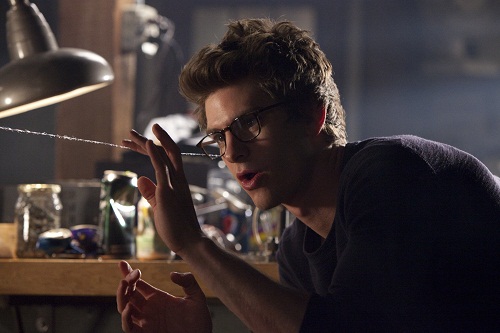
Mechanical web-shooters are back this time round, and show
a lot more versatility than just the web-slinging we've come to expect
It’s not a coincidence that Peter Parker is at Oscorp that day he gets bitten; he’s just learned his father’s long-term business partner Curt Connors works there. It’s no longer coincidence that he gets bitten by a genetically modified spider; he’s snooping for answers among the research his father and Connors had been working on at the time of the former’s disappearance.

It’s not a coincidence that Peter is out on the street the night his uncle dies, nor a coincidence that the same gunman Peter lets escape is the one that kills his Uncle Ben (Ben is following Peter at the time and is willing to act in the greater good when Peter is not). Peter doesn’t start his superhero career out of altruism, he is hunting down his uncle’s murderer and he doesn’t upgrade to hero until another of his mistakes spills out of control.

Everything that takes place throughout the first half of the film is very tightly plotted and very much tied into who Peter Parker is and the circumstances that caused him to be that way. Spider-man’s famous credo “with great power comes great responsibility” is never said in the film. It isn’t needed. After the film’s instigating incident, a fairly innocuous basement flood, Peter’s actions drive pretty much every single event of the film , including the creation of its villain – and he knows it.

In short, it’s been a long time since the character of Peter Parker was ever this interesting and an even longer time since Peter Parker was more interesting than his masked counterpart.

Spider-man loses his mask a lot in this film -
apparently no one wants to cover up that face
It doesn’t hurt at all of course that Parker (and Spidey) are portrayed by Andrew Garfield, one of this generations best young male actors. Though Tobery Maguire acquitted himself well in Raimi’s exuberant, over-earnest Spider-man universe, Garfield carries a lot more in terms of nuance, internal conflict and the realization of his crushing responsibility – often with subtle inflections in his gaze alone. I have to confess, I’m somewhat of a hipster douchebag when it comes to Garfield (I’ve been a fan since his earlier turn in indie fave Boy A) but he acquits himself admirably as the centerpiece of a mainstream Hollywood hit.

Gwen, attempting to stand by her man.
Actually, the acting is one of the strongest facets of the new Spider-man franchise. I’m not so ready to dismiss Kirsten Dunst as some are, but Emma Stone certainly shines as Gwen Stacy, the love interest this time round (in comic continuity, Gwen was one of Peter’s early big name girlfriends). She’s goofy, she’s funny and just geeky enough to explain why the hottest girl in school would be drawn to a blustering shy introvert whose genius apparently only nearly rivals her own.

Of course we can expect Peter’s surrogate parents Uncle Ben and Aunt May to be impressive given that they’re portrayed by Hollywood stalwarts Martin Sheen and Sally Field respectively. Sheen, in particular, deserves credit here. Uncle Ben gets less screen time than May but is responsible for giving Spider-man his whole raison d’être and the mixture of humility, courage, and authority that Sheen brings to the role completely sells Peter’s guilt at failing his too-all-intents father and the lesson he finally learns from him on a bridge in Manhattan.

If the acting falls down anywhere, it may be with Rhys Ifans as the intermittently villainous Dr Curt Connors/The Lizard. I have to back down here a little as I’ve never been a fan of Ifans and may be clouded in my judgement. To Ifans’ credit he handles the Connors side of the role relatively well given the way it is written (I’m used to the Lizard’s human side being slightly less aloof and miss Dylan Baker’s fatherly concern a bit) but falls apart once the Lizard personality starts taking over.

As I imply, this may even be an issue with the script because if there is one area that The Amazing Spider-man falls down (and it’s possible there is only one), it’s the execution of the villain. But that’s a big stumbling block.

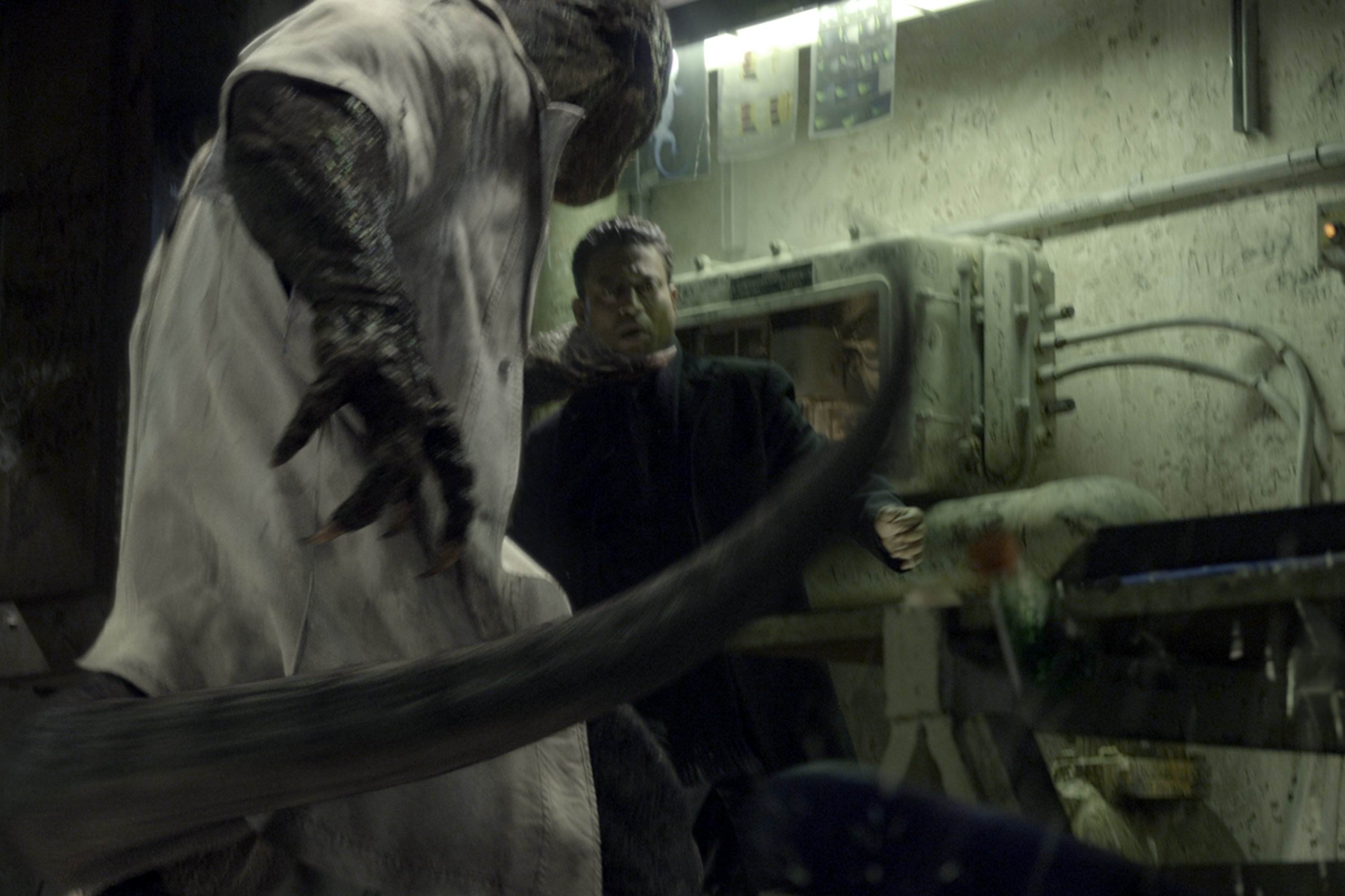
Credit where it's due, the CGI is pretty seamless here.
To be blunt, The Lizard doesn’t work. Although the script does its best work in the set-up (Connor’s research into transgenic gene splicing is the same technology that drives Peter’s spider bite) after Connor’s hotheaded decision to test his technology on himself (has the man never read Jekyll and Hyde?) it all falls apart. The Lizard’s motives are not clear for the most part. His initial rampage seems an ill guided attempt to save some veterans from experimentation but his subsequent plot is to turn everyone into lizards. It doesn’t mesh. There’s a vaguely Nazi-esque desire to see humanity purged of imperfection but n explanation as to how being an enormous gecko might represent that goal.

Also, in this day and age it’s a little hard to buy into the idea that being an amputee would cause such a single-minded obsession with cellular regrowth. If I were an amputee I’d be a little offended that the script thinks I’m so incapable of coping (though again, to be fair, Connor’s motivation dates back to the Silver Age).

All in all, I think The Amazing Spider-man is an extremely healthy start to the franchise’s reboot and has set itself up well for what I hope to be an even tighter sequel.

Friday, 20 July 2012

Film #42 - Brave


I suppose I owe you a review on Brave then, given it’s nearly a week since I saw it and over a month since it came out?

When I first heard that Pixar had been taken over by Disney in 2006, I was a mite concerned. This was the studio that had churned out stellar animated features like Finding Nemo and The Incredible (which  do love, despite my severe misgivings about the elitist ideology in the subtext). But then Ratatouille (2007) came out, then Wall-E (2008), then Up(2009) and it appeared that any doubts I might have had were just me feeling over-protective of a beloved property.

So, given that I skipped out on both Toy Story 3 and Cars 2, it wasn’t until 2012 that I really saw the shadow of the Mouse House loom large over Pixar – and that was with this year’s outing Brave.

I make that sound like a bad thing but it’s really not. Disney has its run in the early 90s of nailing the animated feature and since then may have fallen behind the times in terms of knocking things out of the park but has still managed to produce some regularly entertaining features even right up to last year’s Tangled (I’m a big fan of The Princess and the Frog for example).

It’s just that Pixar had set the bar so, so much higher.

Again, I make it sound like Brave is a bad film. It’s not. It’s actually quite good. It’s just not the treat you spend all year waiting for, marking days off your calendar with a thick red pen until release date is finally here.

Let’s talk about what the film actually is about for a moment.

Brave is the story of 10th century Scottish highland princess Merida (one wonders if the emphasis on ‘princess’ is a Disney innovation and whether Merida will be joining the Disney Princess merchandising line up soon).

Far from being a standard princess, Merida is instead the standard rebellious young woman. She chafes at the expectations placed on her gender, preferring to ride horses bareback, firing arrows (all the proto-feminists in the post-Katniss world need to be archers apparently) and clambering over the picturesque Scottish landscape.

This picture pretty much sums up Act One.
Back at home, Merida frequently butts heads where her mother Queen Elinor over the latter’s attempts to prepare her for her impending womanhood and the vagaries of being of the ‘fairer’ sex in a society where wildness is still something to be prized – if you’re a man.

Learning that she is shortly to be married off against her will to one of three equally unappealing rival princes, Merida takes matters into her own hands and flees into the wilderness, stumbling across a witch living deep within the forest who promises to change Merida’s fate - by changing Elinor.

Unfortunately the change is rather more drastic than Merida had planned and she unwittingly places her mother under a dire curse that will cause Elinor to be hunted down by her own husband and the entire Scottish court. Forced to flee from home, the pair must finally work together to discover how the curse on Elinor works – and how to break it – before the effect of the curse becomes permanent.
As you can probably tell, the focus here isn’t really on the action of the piece so much as it is the examination of the strained relationship between too strong-willed women, though there certainly are more than enough set-pieces to keep boys engaged in Brave’s narrative. Merida is feisty, athletic, quick-witted and particularly good with her bow (there’s a nice nod to Robin Hood in Act One that leaves little doubt that this girl means business). That’s probably just as well as, while the action sequences are engaging, they rarely feel like they’re building to a grand finale so much just bridging the gaps between the last and next heartfelt conversation between Merida and Elinor.

And that may be my main beef with Brave, if I can be said to have a beef at all. It seems to pull its punches when it comes to the more objectives threats offered up by the narrative. For Elinor, Merida’s upcoming nuptials are vital to keeping the peace between the disparate clans on the highlands. We’re told that, if Merida does not marry one of the princes on offer, all-out war will break out and destroy them all. Yet, when the various factions arrive, they are all treated comically and the supposed threat that keeps Elinor up at night comes across as a fairly good-natured rambunctious barroom brawl.

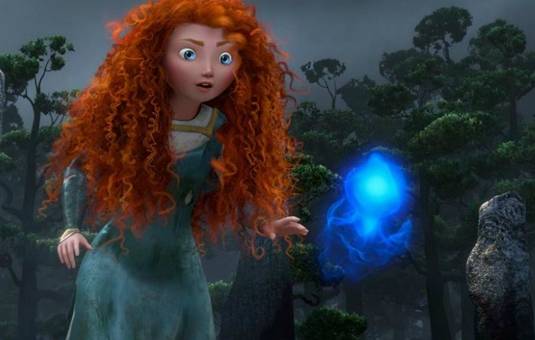
There's just enough of the supernatural in Brave to keep things
humming without it turning into a film about the supernatural
Similarly, a subplot about an evil prince of yesteryear who may still be haunting the area today is threaded into the narrative in Act One. There’s a sense that Merida’s contract with the witch may have unbalanced the world in a way that will enable this villain to rise again and conquer all. Yet, when the threat does emerge, the villain is in such a degraded state that he becomes the catalyst for an action sequence for Merida and Elinor to escape rather than something they will have to team up to overcome.

There’s a reason for this of course. Pixar movies have long been known for their ability to inject real heart into their storylines – and Brave is no exception. The real stakes in Brave  aren’t the threat of violence or conquest but rather the sense that what Merida has done to her mother will permanently end the relationship between them and the film does an excellent job of setting up how devastating that would be.

I guess I just want my cake and to eat it to; to have a film where the emotional stakes and the dramatic stakes hold equal importance and Brave just doesn’t tread this line as well as Wall-E or Up did. Maybe it’s just that I’m a boy, and this is definitely a film with female audience members in mind.

And so we get to the thing I’m always banging on about: the feminist underpinnings in Brave.

I’ve been a bit flip in my comparison between Merida and Katniss Everdeen earlier in that we seem to have established a cliché of what the feminist hero is and how she acts. In the post-Buffy world, she’s become almost commonplace (even the confectionery TV series Teen Wolf has its bow-wielding heroine Alison) which has been a great thing for young women to grow up alongside.

And that’s kind of the downfall of the cliché in many ways, it’s no longer enough to just shout “Girl Power!” and consider patriarchal narratives to be turned on their heads. The figure is now too commonplace and too many movies and TV shows do it too lazily for it to be ffective anymore (I’m reminded of Lisa Simpson valiantly applying to the Little League football team only to be chagrined to discover that it already has several female members).

Feisty girl with archery equipment? Stop me if
you've heard this before.
So, is Brave guilty of this? Putting a bow in a girl’s hand and calling itself provocative when it’s just derivative? Having a protagonist say ‘I will not marry’ and expecting to say something girls haven’t already heard several times before?

In a word, no. But it’s not necessarily obvious from the outside.

Because Merida does do all of these things and a less subtle film may leave it at that. But instead, Brave offers a counterpoint strong female character in Queen Elinor, who is also a potential feminist icon but who brings in a totally different understanding of gender and power.  Where Merida seeks to gain agency by bucking against a patriarchal system, Elinor has already gained it by working within the same system.

Technically, these are characters. You really
don't need to know anything about them though
There is never any question about it, Elinor is absolutely the real ruler of the Scottish highlands. Although she exhibits a genuine affection for her husband King Fergus, he defers to her in the administering of his state. 

When the first brawl breaks out between the various Scottish clans, Fergus can’t help but join in; it is Elinor who has the authority to make them cease. When Merida’s rejection of all suitors threatens civil war, the clan chiefs do not call upon Fergus for mediation, they demand to know what Elinor has decided to do about it. When Merida tries to pacify them, she does not call on her father for help, she channels her mother’s words and wisdom to get her point across.  

Men in Brave are almost an afterthought, it is the women’s narratives that count.

Too often, the cliché of a feminist hero is merely a cheap call of fury against an established power and not an examination of how that established power works. If Brave were not a good film, Elinor would be an out-and-out villain, an unsympathetic mother unheeding of her daughter’s desperate need to be her own person. But she’s not.

Goddamnit, stop trying to gain agency by
contradicting my attempts to give you agency.
Elinor never comes across as anything other than a caring mother. She has attained her agency from the rituals of femininity and that has shaped how she understands power to be attained. Her attempts to tutor Merida in womanhood is less an attempt to constrain her agency but rather an effort to show her how to reach a position where she can channel it more effectively. We know from the storyline that Elinor went through the same dilemma ahead of her marriage to Fergus that Merida faces now (amusingly, Fergus has never considered this point before Elinor blithely lets it slip out) but has come through the other side with a richer life and the ability to call the shots from within the expectations placed on her gender.

It’s just that Merida sees a completely different way to achieve the same goal.

That’s one of the really delightful and interesting things about Brave – that both characters want the same thing for Merida but are at loggerheads over how to achieve them. They each come from a position that seems at eternal conflict with the other but, as the film’s narrative progresses, develop mutual respect for the other and reach a point where the barriers between their ideals become malleable.

I like this, not just as a message for young women but for anyone. You don’t have to choose between being Merida, outside society demanding a world of your own, and Elinor, wielding great power but always peripherally. You can be a blend of them creating you own version of your identity without having to go to either extreme. That is essentially Merida’s journey throughout the film and I think Brave is richer for it.

Indeed, if the actual narrative of Brave had matched the sophistication of its emotional narrative, I’d probably say that Brave was among the stronger of Pixar’s films to date. But that slip up on the action side isn’t a small one in a film like this and I’ve seen Pixar do this much better several times before.

All in all, Brave is well worth seeing, particularly for young’uns, but don’t be surprised if you don’t feel compelled to watch it again even a few years later.