
And
so we get to arguably the summer’s biggest flick – the culmination to
Christopher Nolan’s sprawling Gotham trilogy, The Dark Knight Rises.
By
this stage both Nolan and his trilogy have had so much adulation lapping at
their feet that it’s nearly impossible to say anything against The Dark Knight Rises and not come
across as being a bit contrary. Yet, for all of Nolan intricate cerebral
mechanics and call backs to Batman Begins
and the Dark Knight, the lustre
seems to be off a bit this time round and TDKR
impresses more for its intellectual audacity than any visceral joy.
I
know. I’m a hard man to please.
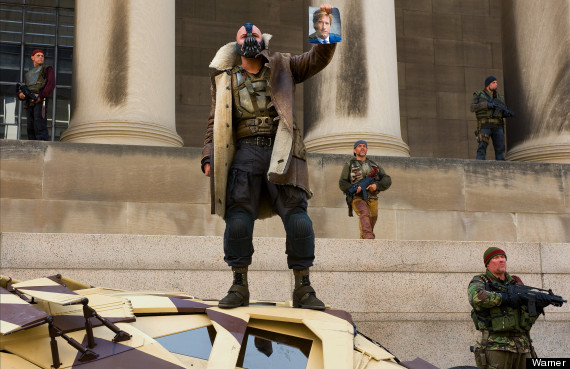 |
| Even Bane is a fanboy |
Set
eight years after the events of The Dark
Knight, Gotham is enjoying a precarious
golden age as the city’s devotion to the deceased Harvey Dent has allowed a
series of draconian laws to be quietly ushered in, breaking the Mob’s grip on
the city. Batman, who took the fall for crimes Dent committed, has vanished and
his alter-ego Bruce Wayne has taken on a Howard Hughes-like existence scuttling
in the abandoned corridors of Wayne Manor. Gotham’s prosperity hasn’t been
universal though and, as the remains of Gotham’s underworld plots to rise
again, they make the mistake of hiring criminal mastermind Bane who promptly
raises an army from among Gotham’s diaspora and readies them for a war much
more wide-reaching than his employers have in mind. As Batman begins to
re-emerge from the shadows, Bane sets his sight on breaking the Bat – in every
conceivable way.
It
sounds like a standalone plot, but one of TDKR’s
major strengths is how well the events of the film tie into events that
happened elsewhere in the trilogy, including many more references to
series-starter Batman Begins that I
would have expected.
But
even as TDKR impresses with its
grandiose vision and complexity of the trilogy as a whole, I’d argue that the
potential flaws in Nolan’s vision have never been so obvious either. I say ‘potential’
because whether you regard them as flaws or not really depends on how much you’ve
bought into what Nolan has been doing quietly to date but which comes back
resoundingly this time around.
It
almost goes without saying that Nolan’s Batman trilogy is not really about
Batman at all but rather Batman merely serves as a convenient symbol for the
city of Gotham
itself. In Begins, the city learns to
rise above the fear that has held it stagnant for decades; in The Dark Knight, it exhibits a core of
goodness and hope that refuses to give in even when it has every reason to. And
in TDKR it pays the brutal price for
not standing up for the values it once aspired to.

It’s
beautiful, laudable stuff. Nolan isn’t really making superhero films here, even
as he reinvents superhero films, so much as gripping crime dramas about nations
of people. The problem is, for me at least, the closer the Bat moves into
symbolism, the sillier the Batman looks in reel life.
Considering
how much TDKR caps off the trilogy,
it’s a little odd that Nolan essentially rescinds the Batman’s use of fear and
secrecy as a crowd control technique here. Batman fights in broad daylight here,
one of a throng of people, his fights in the midst of audiences and appears as
clearly merely a man in front of groups of citizens even as he tries to inspire
with some symbolic pyromania. It may be a metaphor I just don’t get, but I just
don’t get it.
 |
| I'm only using this photo to prove that Bruce does put on the suit at some points |
And
he is undercut in a myriad of ways throughout TDKR. He’s barely onscreen as Bruce Wayne does most of the heavy
lifting, everybody in Gotham seems to know his
secret identity by now and he’s oddly ineffectual. It doesn’t help that his
early set-piece brawl with Bane is portrayed in near-silence, rendering events
strangely boring.
It
kind of overshadows proceedings. Without anyone to really get behind in the
central role, it wasn’t as absorbing an experience as watching The Dark Knight and I often felt more
like a wind-up toy compelled to watch until my spring ran down than an active
participant in the film’s events.
Ironically,
The Dark Knight could probably have
gotten away with more of this, given the mesmeric presence of The Joker to
spice things up. But Bane is no Joker, with all due respect to Tom Hardy who gives
his all. Between the facial expression obscuring mask and the convoluted yet
seemingly directionless plot (does he achieve his goals at the midpoint? Is
there more to his ambition?), he’s not given enough to be a driving force
either.
 |
| She might look like a t cat, but thankfully, she doesn't think she is one. |
Much
more successful and more humane is Anne Hathaway’s turn as the Catwoman, who
(much like Michelle Pfeiffer in Batman Returns)
add a jolt of pleasure nearly every time she’s onscreen. Selena Kyle’s (she’s
never referred to as Catwoman) journey throughout the film is the easiest to
understand and engage with and Hathaway treads just the right line between
mischievous villainy and conflicted pathos to keep us on board. Yes, Kyle is the
stereotypical femme fatale but it’s
not the worst cliché to throw at us and Hathaway at least gets into it with
gusto.

No comments:
Post a Comment