
Kiwi
director Taika Waititi’s Boy is
actually two years old by this point but has only just managed to jump the
Pacific for a Toronto-based release and, having been starved of Australian
content for most of my time here, I was eager to see what the fuss was all
about.
The
fuss, of course, referring to the near-universal acclaim showered on Boy in New Zealand following its release
and where it still holds the record for the highest grossing New Zealand film
of all time (for obvious reasons we’re not counting Lord of The Rings under this category). Even in Australia it
was regarded as one of the best films of 2010.
On
the surface it may seem a bit out of proportion. Boy, after all, is a fairly standard coming-of-age yarn. The
eponymous character, the 11 year old Boy (real name Alamein, and played by
James Rolleston) is growing up in 1984’s Waihau Bayon New Zealand’s east coast,
as the de facto primary caregiver for a large family of cousins and filling the
holes in his life with fantasies about his long-absent father (also Alamein,
and played by Waititi himself) and pop-star Michael Jackson.
Poverty and chronic unemployment abound but through the prism of Boy’s imagination, it’s a fairly idyllic existence. Until the night when Alamein arrives unexpectedly back in Boy’s life and Boy begins a long coming of age where he will be forced to question everything he’s ever believe about his father and the world as he knows it.
Poverty and chronic unemployment abound but through the prism of Boy’s imagination, it’s a fairly idyllic existence. Until the night when Alamein arrives unexpectedly back in Boy’s life and Boy begins a long coming of age where he will be forced to question everything he’s ever believe about his father and the world as he knows it.
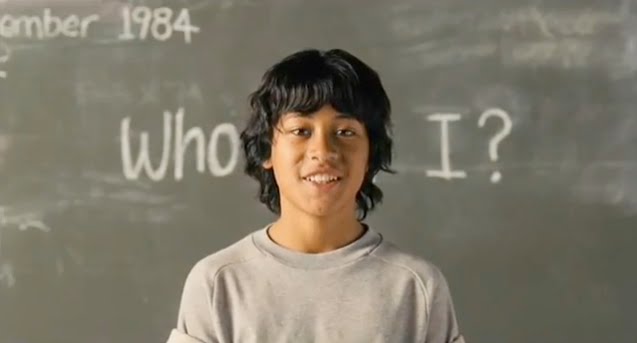 |
| You can see the script redrafting process at work as this question moves out of the centre to make way for "What kind of man will i be?" |
The entire film performs a very delicate tightrope act of dramatic irony where the audience understands full well how dire Boy’s situation really is but the main character’s levels of delusion and optimism manages to keep the real world horrors of poverty, drug use, neglect, and violence at arm’s length from a story that is steeped in them.
Boy is a remarkable feat in that it’s a film that doesn’t pull any punches by pulling all of its punches.
Waititi’s
previous feature, the “rom-com” Eagle vs
Shark, was a master class in sheer awkwardness as the basis for comedy and
Waititi builds on the tricks he deployed there to achieve even greater effect
in Boy.
Whereas EvS laid on stilted dialogue and delusion to make for jokes, the unavoidable humour they create in Boy helps to underline how serious all this stuff really is even as it makes it possible to stomach.
Whereas EvS laid on stilted dialogue and delusion to make for jokes, the unavoidable humour they create in Boy helps to underline how serious all this stuff really is even as it makes it possible to stomach.
At
its heart, Boy is a film about the
way people use their delusions to stop themselves confronting their problems –
and I suspect we’re specifically looking at male delusion here.
 |
| The men of 'Boy' in order of how seriously they take this game from left to right |
Alamein
has fantasies of himself as a big time gangster exerting influence over his
contemporaries even though he refuses to work to achieve any of his goals.
Boy will not look past his image of a perfect father figure to see that his abusive pa has severe feet of clay.
Even Boy’s six year old brother Rocky wraps himself up in the conviction that he has superpowers as a way of exploring his guilt over the fact their mother died during his birth.
Boy will not look past his image of a perfect father figure to see that his abusive pa has severe feet of clay.
Even Boy’s six year old brother Rocky wraps himself up in the conviction that he has superpowers as a way of exploring his guilt over the fact their mother died during his birth.
By
the film’s climax, all three will have to make a choice about whether to
continue deceiving themselves and sabotaging themselves or whether to start
living in the grim world the way that it actually is and the nuanced way in
which each arrives at that point and what they do once there is captivating.
 |
| Seriously, sit through the credits for this sequence. |
Boy and his clan may not have a lot of options on the horizon but they’re so likeable as they fail that you can’t help wanting to go along for the ride.
Waititi, as Alamein, has the hardest job here as his character has such a damaging effect on his sons that it’s near impossible to sympathise with him as her terrorises and disappoints them but Waititi is so adept at playing up just how deeply Alamein doesn’t get it that you can at least understand his devastation at the realisation that his life has been a joke even if you can’t forgive him for it.
But
as always seems to be the case with these films, it’s the kids that steal the
show. And though James Rolleston’s mixture of bravura and innocence hit the
target bang on, it’s Te Aho Aho Eketone-Whitu as Rocky that stayed with me
after the show. For a six year old actor, Rocky comes across with more gravitas
and understanding than anyone else in the film and figures out what needs to be
figured out long before either Boy or Alamein.
 |
| There are women in Boy. The fact their stories are not covered at all is, for once, not an oversight so much as a point about the inner lives of the central characters |
Some
slight caveats here. Boy is a slow
burner and big on its subtlety so it’s more suited for an arthouse mindset than
a cineplex one and North Americans are likely to struggle with the Kiwi
accents.
If you’re willing to adapt though, Boy is a thoroughly enjoyable, scarily accessible window onto a time and culture that feels sufficiently different to be a new experience yet familiar enough to feel like home.
If you’re willing to adapt though, Boy is a thoroughly enjoyable, scarily accessible window onto a time and culture that feels sufficiently different to be a new experience yet familiar enough to feel like home.

No comments:
Post a Comment